Articles | Volume 12, issue 1
https://doi.org/10.5194/ms-12-639-2021
© Author(s) 2021. This work is distributed under
the Creative Commons Attribution 4.0 License.
https://doi.org/10.5194/ms-12-639-2021
© Author(s) 2021. This work is distributed under
the Creative Commons Attribution 4.0 License.
Design and evaluation of a novel upper limb rehabilitation robot with space training based on an end effector
Qiaoling Meng
Institute of Rehabilitation Engineering and Technology, University of Shanghai for Science and Technology, Shanghai 200093, China
Shanghai Engineering Research Center of Assistive Devices, Shanghai 200093, China
Key Laboratory of Neural-functional Information and Rehabilitation Engineering of the Ministry of Civil Affairs, Shanghai 200093, China
Zongqi Jiao
Institute of Rehabilitation Engineering and Technology, University of Shanghai for Science and Technology, Shanghai 200093, China
Shanghai Engineering Research Center of Assistive Devices, Shanghai 200093, China
Key Laboratory of Neural-functional Information and Rehabilitation Engineering of the Ministry of Civil Affairs, Shanghai 200093, China
Hongliu Yu
CORRESPONDING AUTHOR
Institute of Rehabilitation Engineering and Technology, University of Shanghai for Science and Technology, Shanghai 200093, China
Shanghai Engineering Research Center of Assistive Devices, Shanghai 200093, China
Key Laboratory of Neural-functional Information and Rehabilitation Engineering of the Ministry of Civil Affairs, Shanghai 200093, China
Weisheng Zhang
Institute of Rehabilitation Engineering and Technology, University of Shanghai for Science and Technology, Shanghai 200093, China
Shanghai Engineering Research Center of Assistive Devices, Shanghai 200093, China
Key Laboratory of Neural-functional Information and Rehabilitation Engineering of the Ministry of Civil Affairs, Shanghai 200093, China
Related authors
Cuizhi Fei, Zongqi Jiao, Qiaoling Meng, Bangke Zhang, and Xuhua Lu
Mech. Sci., 17, 453–467, https://doi.org/10.5194/ms-17-453-2026, https://doi.org/10.5194/ms-17-453-2026, 2026
Short summary
Short summary
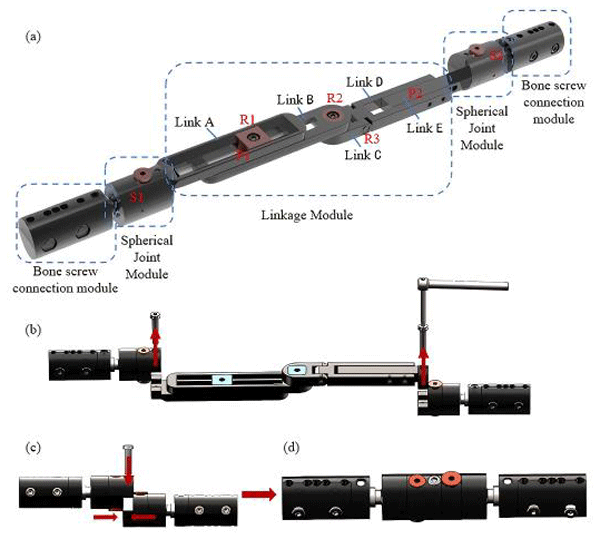
The reconfigurable external fixation based on the seven-link mechanism has configurations in multiple dimensions, multiple postures, and multiple fracture scenarios, enabling rapid and stable fixation of fractures in the femur, tibia, elbow joint, knee joint, and ankle joint. It has been verified that this external fixation has stable structure and reliable fixation and significantly shortens the operation time and can be used for temporary fracture fixation in emergency medical scenarios.
Rongna Xu, Qiaoling Meng, Qiaolian Xie, Yuxin Zheng, Cuizhi Fei, Vincenzo Parenti Castelli, and Hongliu Yu
Mech. Sci., 16, 61–73, https://doi.org/10.5194/ms-16-61-2025, https://doi.org/10.5194/ms-16-61-2025, 2025
Short summary
Short summary
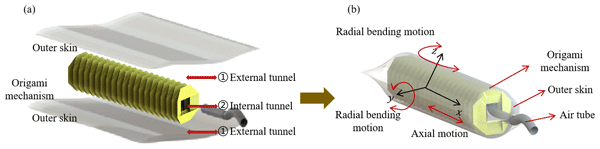
This paper proposes a novel dual-tunnel soft pneumatic origami actuator to provide a large maximum shrinkage rate for reciprocating motion. A programmed design method is proposed based on the geometric parameter model and stiffness model of the actuator. In comparison to other actuators, this actuator weighs only 5 g, and the force-to-weight ratio is 600. The maximum shrinkage rate of the actuator is 61 %, increasing the potential for lightweight and compact devices.
Qiaolian Xie, Qiaoling Meng, Wenwei Yu, Rongna Xu, Zhiyu Wu, Xiaoming Wang, and Hongliu Yu
Mech. Sci., 14, 159–170, https://doi.org/10.5194/ms-14-159-2023, https://doi.org/10.5194/ms-14-159-2023, 2023
Short summary
Short summary
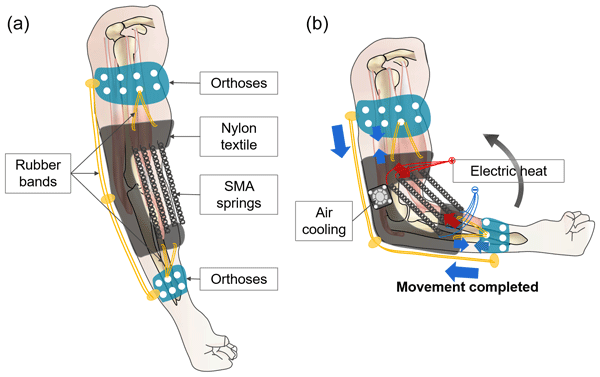
This paper presents a novel soft bionic elbow exoskeleton based on shape metal alloy (SMA) actuators (Sobee-SMA). The exoskeleton adopts a bionic design, combining active deformation material SMA and high elastic material rubber band to simulate the contraction and relaxation of the elbow skeletal muscle. According to the static analysis of the human–exoskeleton coupling model and experiments, the exoskeleton provides elbow-assisted motion and ensures the safety of the thermal heating process.
Qiaoling Meng, Yiming Yue, Sujiao Li, and Hongliu Yu
Mech. Sci., 13, 675–685, https://doi.org/10.5194/ms-13-675-2022, https://doi.org/10.5194/ms-13-675-2022, 2022
Short summary
Short summary
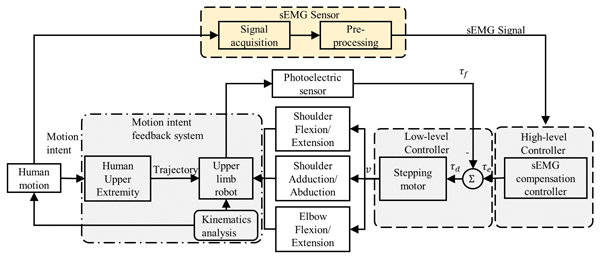
This paper proposes a novel EMG-based motion compensation controller in active training control to improve patients’ active participation. After proposing an upper limb rehabilitation robot and doing the path plan, the EMG compensation experiments and the active training control experiment are done to prove that the method can control the robot in providing auxiliary force according to patients’ motion intents. The robot can guide the patients in implementing reference tasks in active training.
Qiaoling Meng, Mingpeng Jiang, Zongqi Jiao, and Hongliu Yu
Mech. Sci., 13, 1–13, https://doi.org/10.5194/ms-13-1-2022, https://doi.org/10.5194/ms-13-1-2022, 2022
Short summary
Short summary
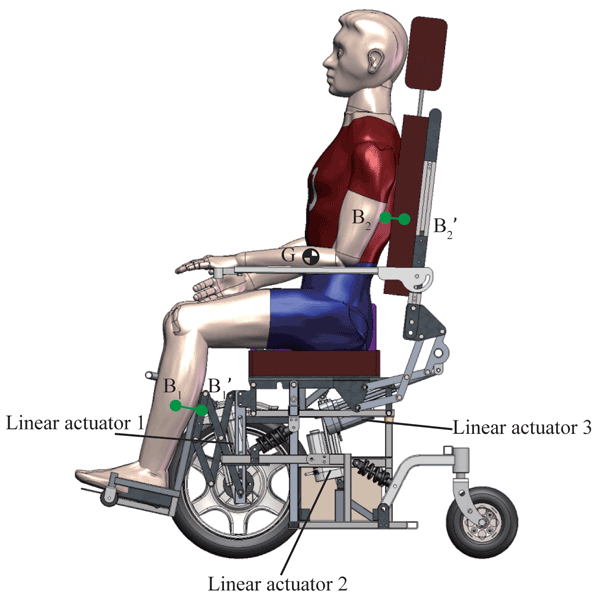
This paper proposes a bionic, multi-posture wheelchair, based on the proposed human–wheelchair coupling model, according to the movement characteristics and requirements. The two key factors in designing the multi-posture wheelchair, the consistency of the motion center and the compensation of the shifting center of gravity, are analyzed in this paper. The novel multi-posture wheelchair can implement the sit-to-lie and sit-to-stand transformations with a maximum slipping distance of 10.5 mm.
Qiaolian Xie, Qiaoling Meng, Qingxin Zeng, Hongliu Yu, and Zhijia Shen
Mech. Sci., 12, 661–675, https://doi.org/10.5194/ms-12-661-2021, https://doi.org/10.5194/ms-12-661-2021, 2021
Short summary
Short summary
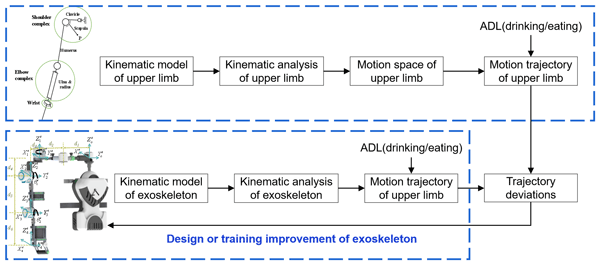
This paper proposes a new 13 degrees of freedom equivalent kinematic model for the human upper limb and fully considers the movement characteristics of human upper limbs in anatomy. The proposed model can be utilized to analyze the human upper limb workspace and joint motions. Furthermore, the model can effectively evaluate the existing upper limb exoskeleton and provide suggestions for structural improvements in line with human motion.
Cuizhi Fei, Zongqi Jiao, Qiaoling Meng, Bangke Zhang, and Xuhua Lu
Mech. Sci., 17, 453–467, https://doi.org/10.5194/ms-17-453-2026, https://doi.org/10.5194/ms-17-453-2026, 2026
Short summary
Short summary
The reconfigurable external fixation based on the seven-link mechanism has configurations in multiple dimensions, multiple postures, and multiple fracture scenarios, enabling rapid and stable fixation of fractures in the femur, tibia, elbow joint, knee joint, and ankle joint. It has been verified that this external fixation has stable structure and reliable fixation and significantly shortens the operation time and can be used for temporary fracture fixation in emergency medical scenarios.
Rongna Xu, Qiaoling Meng, Qiaolian Xie, Yuxin Zheng, Cuizhi Fei, Vincenzo Parenti Castelli, and Hongliu Yu
Mech. Sci., 16, 61–73, https://doi.org/10.5194/ms-16-61-2025, https://doi.org/10.5194/ms-16-61-2025, 2025
Short summary
Short summary
This paper proposes a novel dual-tunnel soft pneumatic origami actuator to provide a large maximum shrinkage rate for reciprocating motion. A programmed design method is proposed based on the geometric parameter model and stiffness model of the actuator. In comparison to other actuators, this actuator weighs only 5 g, and the force-to-weight ratio is 600. The maximum shrinkage rate of the actuator is 61 %, increasing the potential for lightweight and compact devices.
Qiaolian Xie, Qiaoling Meng, Wenwei Yu, Rongna Xu, Zhiyu Wu, Xiaoming Wang, and Hongliu Yu
Mech. Sci., 14, 159–170, https://doi.org/10.5194/ms-14-159-2023, https://doi.org/10.5194/ms-14-159-2023, 2023
Short summary
Short summary
This paper presents a novel soft bionic elbow exoskeleton based on shape metal alloy (SMA) actuators (Sobee-SMA). The exoskeleton adopts a bionic design, combining active deformation material SMA and high elastic material rubber band to simulate the contraction and relaxation of the elbow skeletal muscle. According to the static analysis of the human–exoskeleton coupling model and experiments, the exoskeleton provides elbow-assisted motion and ensures the safety of the thermal heating process.
Qiaoling Meng, Yiming Yue, Sujiao Li, and Hongliu Yu
Mech. Sci., 13, 675–685, https://doi.org/10.5194/ms-13-675-2022, https://doi.org/10.5194/ms-13-675-2022, 2022
Short summary
Short summary
This paper proposes a novel EMG-based motion compensation controller in active training control to improve patients’ active participation. After proposing an upper limb rehabilitation robot and doing the path plan, the EMG compensation experiments and the active training control experiment are done to prove that the method can control the robot in providing auxiliary force according to patients’ motion intents. The robot can guide the patients in implementing reference tasks in active training.
Qiaoling Meng, Mingpeng Jiang, Zongqi Jiao, and Hongliu Yu
Mech. Sci., 13, 1–13, https://doi.org/10.5194/ms-13-1-2022, https://doi.org/10.5194/ms-13-1-2022, 2022
Short summary
Short summary
This paper proposes a bionic, multi-posture wheelchair, based on the proposed human–wheelchair coupling model, according to the movement characteristics and requirements. The two key factors in designing the multi-posture wheelchair, the consistency of the motion center and the compensation of the shifting center of gravity, are analyzed in this paper. The novel multi-posture wheelchair can implement the sit-to-lie and sit-to-stand transformations with a maximum slipping distance of 10.5 mm.
Qiaolian Xie, Qiaoling Meng, Qingxin Zeng, Hongliu Yu, and Zhijia Shen
Mech. Sci., 12, 661–675, https://doi.org/10.5194/ms-12-661-2021, https://doi.org/10.5194/ms-12-661-2021, 2021
Short summary
Short summary
This paper proposes a new 13 degrees of freedom equivalent kinematic model for the human upper limb and fully considers the movement characteristics of human upper limbs in anatomy. The proposed model can be utilized to analyze the human upper limb workspace and joint motions. Furthermore, the model can effectively evaluate the existing upper limb exoskeleton and provide suggestions for structural improvements in line with human motion.
Cited articles
Ahmad, M., Kumar, N., and Kumari, R.:
A hybrid genetic algorithm approach to solve inverse kinematics of a mechanical manipulator,
International Journal of Scientific & Technology Research,
8, 1772–1782, 2019.
Béjot, Y., Daubail, B., and Giroud, M.:
Epidemiology of stroke and transient ischemic attacks: Current knowledge and perspectives,
Rev. Neurologia (Paris),
172, 59–68, 2016.
Bertani, R., Melegari, C., De Cola, M. C., Bramanti, A., Bramanti, P., and Calabrò, R. S.:
Effects of robot-assisted upper limb rehabilitation in stroke patients: a systematic review with meta-analysis,
Neurol. Sci., 38, 1561–1569, https://doi.org/10.1007/s10072-017-2995-5, 2017.
Cardou, P., Bouchard, S., and Gosselin, C.:
Kinematic-sensitivity indices for dimensionally nonhomogeneous jacobian matrices,
IEEE T. Robot.,
26, 166–173, https://doi.org/10.1109/TRO.2009.2037252, 2010.
Chang, C. K., Washabaugh, E. P., Gwozdziowski, A., Remy, C. D., and Krishnan, C.:
A Semi-passive Planar Manipulandum for Upper-Extremity Rehabilitation,
Ann. Biomed. Eng.,
46, 1047–1065, https://doi.org/10.1007/s10439-018-2020-z, 2018.
Gates, D. H., Walters, L. S., Cowley, J., Wilken, J. M., and Resnik, L.:
Range of motion requirements for upper-limb activities of daily living,
Am. J. Occup. Ther.,
70, 1–10, https://doi.org/10.5014/ajot.2016.015487, 2016.
Gunasekara, M., Gopura, R., and Jayawardena, S.:
6-REXOS: Upper limb exoskeleton robot with improved pHRI,
Int. J. Adv. Robot. Syst.,
12, 1–13, https://doi.org/10.5772/60440, 2015.
Hogan, N., Krebs, H. I., Charnnarong, J., Srikrishna, P., and Sharon, A.: MIT-MANUS: a workstation for manual therapy and training. I, in: IEEE International Workshop on Robot and Human Communication, Tokyo, Japan, 1–3 September 1992, 161–165, 1992.
Jarrase, N., Maestrutti, M., Morel, G., and Roby-Brami, A.:
Robotic prosthetics: beyond the technical performance: A study of socio-anthropological and cultural phenomena influencing the appropriation of technical objects interacting with the body,
IEEE Technol. Soc. Mag.,
34, 71–79, 2015.
Kikuchi, T., Nagata, T., Sato, C., Abe, I., Inoue, A., Kugimiya, S., Ohno, T., and Hatabe, S.:
Sensibility Assessment for User Interface and Training Program of An Upper-Limb Rehabilitation Robot, D-SEMUL,
Proc. Annu. Int. Conf. IEEE Eng. Med. Biol. Soc. EMBS, Honolulu, Hawaii, 17–21 July 2018, 3028–3031, https://doi.org/10.1109/EMBC.2018.8513074, 2018.
Kim, B. and Deshpande, A. D.:
An upper-body rehabilitation exoskeleton Harmony with an anatomical shoulder mechanism: Design, modeling, control, and performance evaluation,
Int. J. Robot. Res.,
36, 414–435, https://doi.org/10.1177/0278364917706743, 2017.
Kim, J. O. and Khosla, P.: Dexterity measures for design and control of manipulators, in: IEEE/RSJ International Workshop on Intelligent Robots and Systems '91, Osaka, Japan, 3–5 November 1991, 758–763, 1991.
Loureiro, R., Amirabdollahian, F., Topping, M., Driessen, B., and Harwin, W.: Upper Limb Robot Mediated Stroke Therapy–GENTLE/s Approach, Autonomous Robots., 15, 35–51, https://doi.org/10.1023/A:1024436732030, 2003.
Lum, P. S., Burgar, C. G., Shor, P. C., Majmundar, M., and Van der Loos, M.:
Robot-assisted movement training compared with conventional therapy techniques for the rehabilitation of upper-limb motor function after stroke,
Arch. Phys. Med. Rehab.,
83, 952–959, https://doi.org/10.1053/apmr.2001.33101, 2002.
Luo, L., Peng, L., Wang, C., and Hou, Z. G.:
A Greedy Assist-as-Needed Controller for Upper Limb Rehabilitation,
IEEE T. Neur. Net. Lear.,
30, 3433–3443, https://doi.org/10.1109/TNNLS.2019.2892157, 2019.
Lynch, K. M. and Park, F. C.: Modern Robotics: Mechanics, Planning, and Control, Cambridge Univeristy Press, 2017.
Magermans, D. J., Chadwick, E. K. J., Veeger, H. E. J., and Van Der Helm, F. C. T.:
Requirements for upper extremity motions during activities of daily living,
Clin. Biomech.,
20, 591–599, https://doi.org/10.1016/j.clinbiomech.2005.02.006, 2005.
Manna, S. K. and Dubey, V. N.: A mechanism for elbow exoskeleton for customised training, in: 2017 International Conference on Rehabilitation Robotics (ICORR), London, UK, 17–20 July 2017, 1597–1602, 2017.
Meng, Q., Xie, Q., Shao, H., Cao, W., Wang, F., Wang, L., Yu, H., and Li, S.:
Pilot Study of a Powered Exoskeleton for Upper Limb Rehabilitation Based on the Wheelchair,
Biomed Res. Int.,
2019, 1–11, https://doi.org/10.1155/2019/9627438, 2019.
Namdari, S., Yagnik, G., Ebaugh, D. D., Nagda, S., Ramsey, M. L., Williams, G. R., and Mehta, S.:
Defining functional shoulder range of motion for activities of daily living,
J. Shoulder Elb. Surg.,
21, 1177–1183, https://doi.org/10.1016/j.jse.2011.07.032, 2012.
Nef, T., Guidali, M., and Riener, R.:
ARMin III – arm therapy exoskeleton with an ergonomic shoulder actuation,
Appl. Bionics Biomech.,
6, 127–142, https://doi.org/10.1080/11762320902840179, 2009.
Otten, A., Voort, C., Stienen, A., Aarts, R., Van Asseldonk, E., and Van Der Kooij, H.:
LIMPACT: A Hydraulically Powered Self-Aligning Upper Limb Exoskeleton,
IEEE/ASME Transactions on Mechatronics,
20, 2285–2298, https://doi.org/10.1109/TMECH.2014.2375272, 2015.
Perry, J. C., Rosen, J., and Burns, S.:
Upper-Limb Powered Exoskeleton Design,
IEEE/ASME Transactions on Mechatronics,
12, 408–417, 2007.
Pons, J. L.:
Wearable Robots: biomechatronic Exoskeletons,
John Wiley & Sons, Inc., New Jersey, USA, 2008.
Rozo, L., Jaquier, N., Calinon, S., and Caldwell, D. G.: Learning manipulability ellipsoids for task compatibility in robot manipulation, 2017 IEEE/RSJ International Conference on Intelligent Robots and Systems (IROS), Vancouver, Canada, 24–28, September 2017, 3183–3189, 2017.
Rubinstein, R. Y. and Kroese, D. P.: Simulation and the Monte Carlo Method,
John Wiley & Sons, Inc., New Jersey, USA, 2017.
Wu, G., Van Der Helm, F. C. T., Veeger, H. E. J., Makhsous, M., Van Roy, P., Anglin, C., Nagels, J., Karduna, A. R., McQuade, K., Wang, X., Werner, F. W., and Buchholz, B.:
ISB recommendation on definitions of joint coordinate systems of various joints for the reporting of human joint motion – Part II: Shoulder, elbow, wrist and hand,
J. Biomech.,
38, 981–992, https://doi.org/10.1016/j.jbiomech.2004.05.042, 2005.
Zhang, L., Li, J., Su, P., Song, Y., Dong, M., and Cao, Q.:
Improvement of human–machine compatibility of upper-limb rehabilitation exoskeleton using passive joints,
Robot. Auton. Syst.,
112, 22–31, https://doi.org/10.1016/j.robot.2018.10.012, 2019.
Short summary
This paper proposes a novel, 4 degrees of freedom, end-effector-based upper limb rehabilitation robot with space training. The robot can assist the human upper limb in performing rehabilitation training of the shoulder flexion/extension and adduction/abduction and elbow flexion/extension. Different from the desktop-type end-effector-based robot, the proposed robot can provide a wide range of shoulder flexion/extension training and cover the range of movement of the human upper limb.
This paper proposes a novel, 4 degrees of freedom, end-effector-based upper limb rehabilitation...