Articles | Volume 13, issue 2
https://doi.org/10.5194/ms-13-675-2022
© Author(s) 2022. This work is distributed under
the Creative Commons Attribution 4.0 License.
https://doi.org/10.5194/ms-13-675-2022
© Author(s) 2022. This work is distributed under
the Creative Commons Attribution 4.0 License.
Electromyogram-based motion compensation control for the upper limb rehabilitation robot in active training
Qiaoling Meng
Institute of Rehabilitation Engineering and Technology, University of
Shanghai for Science and Technology, Shanghai 200093, China
Shanghai Engineering Research Center of Assistive Devices, Shanghai, China
Key Laboratory of Neural-functional Information and Rehabilitation
Engineering of the Ministry of Civil Affairs, Shanghai, China
Yiming Yue
Institute of Rehabilitation Engineering and Technology, University of
Shanghai for Science and Technology, Shanghai 200093, China
Shanghai Engineering Research Center of Assistive Devices, Shanghai, China
Key Laboratory of Neural-functional Information and Rehabilitation
Engineering of the Ministry of Civil Affairs, Shanghai, China
Sujiao Li
Institute of Rehabilitation Engineering and Technology, University of
Shanghai for Science and Technology, Shanghai 200093, China
Shanghai Engineering Research Center of Assistive Devices, Shanghai, China
Key Laboratory of Neural-functional Information and Rehabilitation
Engineering of the Ministry of Civil Affairs, Shanghai, China
Hongliu Yu
CORRESPONDING AUTHOR
Institute of Rehabilitation Engineering and Technology, University of
Shanghai for Science and Technology, Shanghai 200093, China
Shanghai Engineering Research Center of Assistive Devices, Shanghai, China
Key Laboratory of Neural-functional Information and Rehabilitation
Engineering of the Ministry of Civil Affairs, Shanghai, China
Related authors
Cuizhi Fei, Zongqi Jiao, Qiaoling Meng, Bangke Zhang, and Xuhua Lu
Mech. Sci., 17, 453–467, https://doi.org/10.5194/ms-17-453-2026, https://doi.org/10.5194/ms-17-453-2026, 2026
Short summary
Short summary
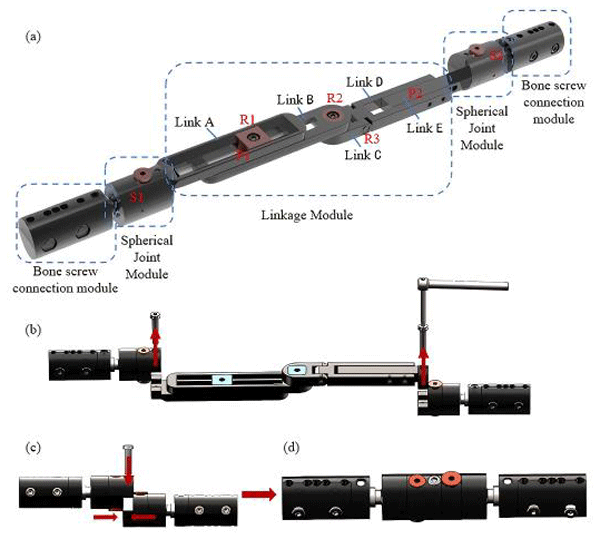
The reconfigurable external fixation based on the seven-link mechanism has configurations in multiple dimensions, multiple postures, and multiple fracture scenarios, enabling rapid and stable fixation of fractures in the femur, tibia, elbow joint, knee joint, and ankle joint. It has been verified that this external fixation has stable structure and reliable fixation and significantly shortens the operation time and can be used for temporary fracture fixation in emergency medical scenarios.
Rongna Xu, Qiaoling Meng, Qiaolian Xie, Yuxin Zheng, Cuizhi Fei, Vincenzo Parenti Castelli, and Hongliu Yu
Mech. Sci., 16, 61–73, https://doi.org/10.5194/ms-16-61-2025, https://doi.org/10.5194/ms-16-61-2025, 2025
Short summary
Short summary
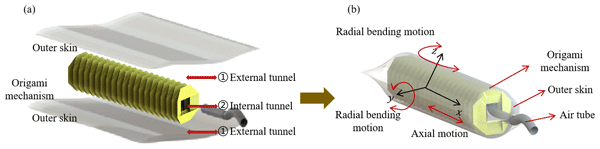
This paper proposes a novel dual-tunnel soft pneumatic origami actuator to provide a large maximum shrinkage rate for reciprocating motion. A programmed design method is proposed based on the geometric parameter model and stiffness model of the actuator. In comparison to other actuators, this actuator weighs only 5 g, and the force-to-weight ratio is 600. The maximum shrinkage rate of the actuator is 61 %, increasing the potential for lightweight and compact devices.
Qiaolian Xie, Qiaoling Meng, Wenwei Yu, Rongna Xu, Zhiyu Wu, Xiaoming Wang, and Hongliu Yu
Mech. Sci., 14, 159–170, https://doi.org/10.5194/ms-14-159-2023, https://doi.org/10.5194/ms-14-159-2023, 2023
Short summary
Short summary
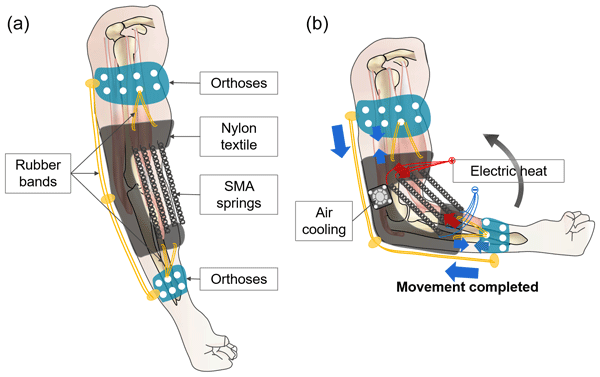
This paper presents a novel soft bionic elbow exoskeleton based on shape metal alloy (SMA) actuators (Sobee-SMA). The exoskeleton adopts a bionic design, combining active deformation material SMA and high elastic material rubber band to simulate the contraction and relaxation of the elbow skeletal muscle. According to the static analysis of the human–exoskeleton coupling model and experiments, the exoskeleton provides elbow-assisted motion and ensures the safety of the thermal heating process.
Qiaoling Meng, Mingpeng Jiang, Zongqi Jiao, and Hongliu Yu
Mech. Sci., 13, 1–13, https://doi.org/10.5194/ms-13-1-2022, https://doi.org/10.5194/ms-13-1-2022, 2022
Short summary
Short summary
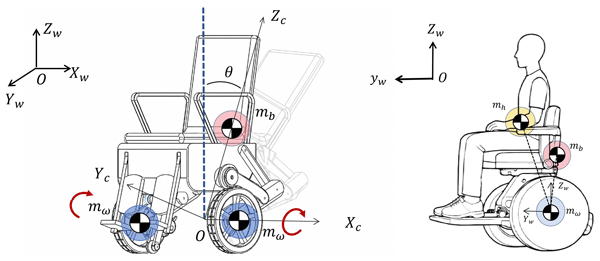
This paper proposes a bionic, multi-posture wheelchair, based on the proposed human–wheelchair coupling model, according to the movement characteristics and requirements. The two key factors in designing the multi-posture wheelchair, the consistency of the motion center and the compensation of the shifting center of gravity, are analyzed in this paper. The novel multi-posture wheelchair can implement the sit-to-lie and sit-to-stand transformations with a maximum slipping distance of 10.5 mm.
Qiaolian Xie, Qiaoling Meng, Qingxin Zeng, Hongliu Yu, and Zhijia Shen
Mech. Sci., 12, 661–675, https://doi.org/10.5194/ms-12-661-2021, https://doi.org/10.5194/ms-12-661-2021, 2021
Short summary
Short summary
This paper proposes a new 13 degrees of freedom equivalent kinematic model for the human upper limb and fully considers the movement characteristics of human upper limbs in anatomy. The proposed model can be utilized to analyze the human upper limb workspace and joint motions. Furthermore, the model can effectively evaluate the existing upper limb exoskeleton and provide suggestions for structural improvements in line with human motion.
Qiaoling Meng, Zongqi Jiao, Hongliu Yu, and Weisheng Zhang
Mech. Sci., 12, 639–648, https://doi.org/10.5194/ms-12-639-2021, https://doi.org/10.5194/ms-12-639-2021, 2021
Short summary
Short summary
This paper proposes a novel, 4 degrees of freedom, end-effector-based upper limb rehabilitation robot with space training. The robot can assist the human upper limb in performing rehabilitation training of the shoulder flexion/extension and adduction/abduction and elbow flexion/extension. Different from the desktop-type end-effector-based robot, the proposed robot can provide a wide range of shoulder flexion/extension training and cover the range of movement of the human upper limb.
Cuizhi Fei, Zongqi Jiao, Qiaoling Meng, Bangke Zhang, and Xuhua Lu
Mech. Sci., 17, 453–467, https://doi.org/10.5194/ms-17-453-2026, https://doi.org/10.5194/ms-17-453-2026, 2026
Short summary
Short summary
The reconfigurable external fixation based on the seven-link mechanism has configurations in multiple dimensions, multiple postures, and multiple fracture scenarios, enabling rapid and stable fixation of fractures in the femur, tibia, elbow joint, knee joint, and ankle joint. It has been verified that this external fixation has stable structure and reliable fixation and significantly shortens the operation time and can be used for temporary fracture fixation in emergency medical scenarios.
Rongna Xu, Qiaoling Meng, Qiaolian Xie, Yuxin Zheng, Cuizhi Fei, Vincenzo Parenti Castelli, and Hongliu Yu
Mech. Sci., 16, 61–73, https://doi.org/10.5194/ms-16-61-2025, https://doi.org/10.5194/ms-16-61-2025, 2025
Short summary
Short summary
This paper proposes a novel dual-tunnel soft pneumatic origami actuator to provide a large maximum shrinkage rate for reciprocating motion. A programmed design method is proposed based on the geometric parameter model and stiffness model of the actuator. In comparison to other actuators, this actuator weighs only 5 g, and the force-to-weight ratio is 600. The maximum shrinkage rate of the actuator is 61 %, increasing the potential for lightweight and compact devices.
Qiaolian Xie, Qiaoling Meng, Wenwei Yu, Rongna Xu, Zhiyu Wu, Xiaoming Wang, and Hongliu Yu
Mech. Sci., 14, 159–170, https://doi.org/10.5194/ms-14-159-2023, https://doi.org/10.5194/ms-14-159-2023, 2023
Short summary
Short summary
This paper presents a novel soft bionic elbow exoskeleton based on shape metal alloy (SMA) actuators (Sobee-SMA). The exoskeleton adopts a bionic design, combining active deformation material SMA and high elastic material rubber band to simulate the contraction and relaxation of the elbow skeletal muscle. According to the static analysis of the human–exoskeleton coupling model and experiments, the exoskeleton provides elbow-assisted motion and ensures the safety of the thermal heating process.
Qiaoling Meng, Mingpeng Jiang, Zongqi Jiao, and Hongliu Yu
Mech. Sci., 13, 1–13, https://doi.org/10.5194/ms-13-1-2022, https://doi.org/10.5194/ms-13-1-2022, 2022
Short summary
Short summary
This paper proposes a bionic, multi-posture wheelchair, based on the proposed human–wheelchair coupling model, according to the movement characteristics and requirements. The two key factors in designing the multi-posture wheelchair, the consistency of the motion center and the compensation of the shifting center of gravity, are analyzed in this paper. The novel multi-posture wheelchair can implement the sit-to-lie and sit-to-stand transformations with a maximum slipping distance of 10.5 mm.
Qiaolian Xie, Qiaoling Meng, Qingxin Zeng, Hongliu Yu, and Zhijia Shen
Mech. Sci., 12, 661–675, https://doi.org/10.5194/ms-12-661-2021, https://doi.org/10.5194/ms-12-661-2021, 2021
Short summary
Short summary
This paper proposes a new 13 degrees of freedom equivalent kinematic model for the human upper limb and fully considers the movement characteristics of human upper limbs in anatomy. The proposed model can be utilized to analyze the human upper limb workspace and joint motions. Furthermore, the model can effectively evaluate the existing upper limb exoskeleton and provide suggestions for structural improvements in line with human motion.
Qiaoling Meng, Zongqi Jiao, Hongliu Yu, and Weisheng Zhang
Mech. Sci., 12, 639–648, https://doi.org/10.5194/ms-12-639-2021, https://doi.org/10.5194/ms-12-639-2021, 2021
Short summary
Short summary
This paper proposes a novel, 4 degrees of freedom, end-effector-based upper limb rehabilitation robot with space training. The robot can assist the human upper limb in performing rehabilitation training of the shoulder flexion/extension and adduction/abduction and elbow flexion/extension. Different from the desktop-type end-effector-based robot, the proposed robot can provide a wide range of shoulder flexion/extension training and cover the range of movement of the human upper limb.
Cited articles
Bai, J., Song, A., Wang, T., and Li, H.: A novel backstepping adaptive
impedance control for an upper limb rehabilitation robot, Comput.
Electr. Eng., 80, 106465, https://doi.org/10.1016/j.compeleceng.2019.106465,
2019.
Bertani, R., Melegari, C., De Cola, M. C., Bramanti, A., Bramanti, P., and
Calabrò, R. S.: Effects of robot-assisted upper limb rehabilitation in
stroke patients: a systematic review with meta-analysis, Neurol.
Sci., 38, 1561–1569, https://doi.org/10.1007/s10072-017-2995-5, 2017.
Brahmi, B., Saad, M., Luna, C. O., Archambault, P. S., and Rahman, M. H.:
Passive and active rehabilitation control of human upper-limb exoskeleton
robot with dynamic uncertainties, Robotica, 36, 1757–1779,
https://doi.org/10.1017/S0263574718000723, 2018.
Büsching, I., Sehle, A., Stürner, J., and Liepert, J.: Using an
upper extremity exoskeleton for semi-autonomous exercise during inpatient
neurological rehabilitation-a pilot study, J. Neuroeng.
Rehabil., 15, 1–7, https://doi.org/10.1186/s12984-018-0415-6, 2018.
Cao, W., Zhang, F., Yu, H., Hu, B., and Meng, Q.: Preliminary research of a
novel center-driven robot for upper extremity rehabilitation, Technol.
Health Care., 26, 409–420, https://doi.org/10.3233/Thc-171060, 2018.
Cao, W., Chen, C., Wang, D., Wu, X., Chen, L., Xu, T., and Liu, J.: A Lower
Limb Exoskeleton with Rigid and Soft Structure for Loaded Walking
Assistance, IEEE Robotics and Automation Letters, 7, 454–461, 2021.
Cui, X., Chen, W., Jin, X., and Agrawal, S. K.: Design of a 7-DOF
cable-driven arm exoskeleton (CAREX-7) and a controller for dexterous motion
training or assistance, IEEE-ASME T. Mech., 22,
161–172, https://doi.org/10.1109/TMECH.2016.2618888, 2016.
Disselhorst-Klug, C., Schmitz-Rode, T., and Rau, G.: Surface electromyography
and muscle force: Limits in sEMG–force relationship and new approaches for
applications, Clin. Biomech., 24, 225–235,
https://doi.org/10.1016/j.clinbiomech.2008.08.003, 2009.
Furukawa, A., Uchida, M., Noguchi, Y., Ito, T., and Aso, C.: Measurement of
patient's upper limbs motor characteristics using upper limb rehabilitation
support system, Measurement: Sensors., 18, 100097,
https://doi.org/10.1016/j.measen.2021.100097, 2021.
Iosa, M., Galeoto, G., De Bartolo, D., Russo, V., Ruotolo, I., Spitoni, G.
F., Ciancarelli, I., Tramontano, M., Antonucci G., Paolucci, S., and Morone,
G.: Italian Version of the Pittsburgh Rehabilitation Participation Scale:
Psychometric Analysis of Validity and Reliability, Brain Sci., 11,
626, https://doi.org/10.3390/brainsci11050626, 2021.
Jakob, I., Kollreider, A., Germanotta, M., Benetti, F., Cruciani, A., Padua,
L., and Aprile, I.: Robotic and sensor technology for upper limb
rehabilitation, Physical Medicine and Rehabilitation, 10, S189–S197, https://doi.org/10.1016/j.pmrj.2018.07.011,
2018.
Khezri, M. and Jahed, M.: An inventive quadratic time-frequency scheme
based on Wigner-Ville distribution for classification of sEMG signals, in:
IEEE 6th International Special Topic Conference on Information Technology
Applications in Biomedicine, 261–264, https://doi.org/10.1109/ITAB.2007.4407397, 2007.
Li, Z., Peng, F., Yan, R., Tang, X., Xin, S. and Wu, J.: A virtual repulsive
potential field algorithm of posture trajectory planning for precision
improvement in robotic multi-axis milling, Robot. CIM-Int.
Manuf., 74, 102288, https://doi.org/10.1016/j.rcim.2021.102288, 2022.
Liu, K., Xiong, C. H., He, L., Chen, W. B., and Huang, X. L.: Postural
synergy based design of exoskeleton robot replicating human arm reaching
movements, Robot. Auton. Syst., 99, 84–96,
https://doi.org/10.1016/j.robot.2017.10.003, 2018.
Madridano, Á., Al-Kaff, A., Martín, D., and de la Escalera, A.:
Trajectory planning for multi-robot systems: Methods and applications,
Expert Syst. Appl., 173, 114660, https://doi.org/10.1016/j.eswa.2021.114660, 2021.
Mead, N. and Bower, P.: Patient-centredness: a conceptual framework and
review of the empirical literature, Soc. Sci. Med., 51,
1087–1110, https://doi.org/10.1016/S0277-9536(00)00098-8, 2000.
Molteni, F., Gasperini, G., Cannaviello, G., and Guanziroli, E.:
Exoskeleton and end-effector robots for upper and lower limbs
rehabilitation: narrative review, Physical Medicine and Rehabilitation, 10, S174–S188, https://doi.org/10.1016/j.pmrj.2018.06.005, 2018.
Reddy, N. P. and Gupta, V.: Toward direct biocontrol using surface EMG
signals: Control of finger and wrist joint models, Med. Eng.
Phys., 29, 398–403, https://doi.org/10.1016/j.medengphy.2005.10.016, 2007.
Sbriccoli, P., Bazzucchi, I., Rosponi, A., Bernardi, M., De Vito, G., and
Felici, F.: Amplitude and spectral characteristics of biceps Brachii sEMG
depend upon speed of isometric force generation, J.
Electromyogr. Kines., 13, 139–147,
https://doi.org/10.1016/S1050-6411(02)00098-6, 2003.
Shi, D., Zhang, W., Zhang, W., and Ding, X.: A review on lower limb
rehabilitation exoskeleton robots, Chin. J. Mech.
Eng., 32, 1–11, https://doi.org/10.1186/s10033-019-0389-8, 2019.
Wang, Y., Wu, Q., Dey, N., Fong, S., and Ashour, A. S.: Deep back
propagation–long short-term memory network based upper-limb sEMG signal
classification for automated rehabilitation, Biocybern. Biomed. Eng., 40, 987–1001, https://doi.org/10.1016/j.bbe.2020.05.003, 2020.
Wu, X., Cao, W., Yu, H., Zhang, Z., Leng, Y., and Zhang, M.: Generating
Electricity during Locomotion Modes Dominated by Negative Work with a Knee
Energy Harvesting Exoskeleton, IEEE-ASME T. Mech.,
https://doi.org/10.1109/TMECH.2022.3157848, online first, 2022.
Short summary
This paper proposes a novel EMG-based motion compensation controller in active training control to improve patients’ active participation. After proposing an upper limb rehabilitation robot and doing the path plan, the EMG compensation experiments and the active training control experiment are done to prove that the method can control the robot in providing auxiliary force according to patients’ motion intents. The robot can guide the patients in implementing reference tasks in active training.
This paper proposes a novel EMG-based motion compensation controller in active training control...