Articles | Volume 17, issue 1
https://doi.org/10.5194/ms-17-439-2026
© Author(s) 2026. This work is distributed under
the Creative Commons Attribution 4.0 License.
https://doi.org/10.5194/ms-17-439-2026
© Author(s) 2026. This work is distributed under
the Creative Commons Attribution 4.0 License.
A multi-segment serial–parallel spatial closed-chain capture mechanism based on bionic principles
Xingqi Yin
Beijing Jiaotong University, Beijing, 100044, China
China Aerospace Science and Technology Corporation, Beijing, 100048, China
Xuemin Sun
CORRESPONDING AUTHOR
Shandong Management University, Jinan, 250100, China
Zhihong Chen
CORRESPONDING AUTHOR
China Aerospace Science and Technology Corporation, Beijing, 100048, China
Xianhong Zhang
Beijing Jiaotong University, Beijing, 100044, China
Ruiming Li
Beijing Jiaotong University, Beijing, 100044, China
Yanan Yao
Beijing Jiaotong University, Beijing, 100044, China
Related authors
No articles found.
Kaisheng Zhang, Xuemin Sun, Ruiming Li, Zhiguo Yu, and Biao Yu
Mech. Sci., 15, 541–553, https://doi.org/10.5194/ms-15-541-2024, https://doi.org/10.5194/ms-15-541-2024, 2024
Short summary
Short summary
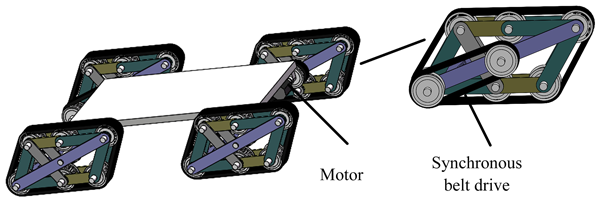
This paper designs a linkage-type self-adaptive deformable tracked mechanism module in accordance with the multi-loop mechanism. The mechanism has two modes of forward movement and reverse movement, including deformable tracked-type and rocker arm-type, respectively. This kind of mechanism has very good terrain adaptability and can deform through passive self-adaptive obstacles, which has certain application prospects in special terrains.
Ruiming Li, Xianhong Zhang, Shuo Zhang, Ran Liu, and Yan-an Yao
Mech. Sci., 14, 387–398, https://doi.org/10.5194/ms-14-387-2023, https://doi.org/10.5194/ms-14-387-2023, 2023
Short summary
Short summary
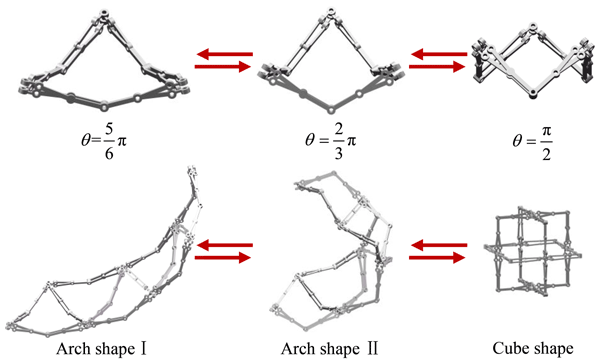
This paper deals with the construction of a novel family of multimode deployable mechanisms. By connecting many identical threefold-symmetric Bricard-like mechanisms, a multimode deployable arch is proposed for the first time, which can switch between the scissor-like deployable mode and the arch deformable mode through the transition configuration. Then, new multimode center-driven deployable mechanisms can be obtained by connecting three and six multimode deployable arches.
Shi-Wu Li, Kan Shi, Ming-Jie Wang, and Yan-An Yao
Mech. Sci., 13, 625–634, https://doi.org/10.5194/ms-13-625-2022, https://doi.org/10.5194/ms-13-625-2022, 2022
Short summary
Short summary
China is one of the first countries that produced textiles in the world. It has designed and developed a variety of equipment to facilitate textile work. However, due to unclear descriptions in the records and illustrations, a variety of designs with different structures may have been produced. This paper briefly analyzes the structures of textile mechanisms and explores the degree of freedom of the mechanisms to find feasible designs in line with functional requirements.
Haiqiang Zhang, Jianglong Tang, Changtao Yan, Guohua Cui, Minghui Zhang, and Yan'an Yao
Mech. Sci., 13, 635–645, https://doi.org/10.5194/ms-13-635-2022, https://doi.org/10.5194/ms-13-635-2022, 2022
Short summary
Short summary
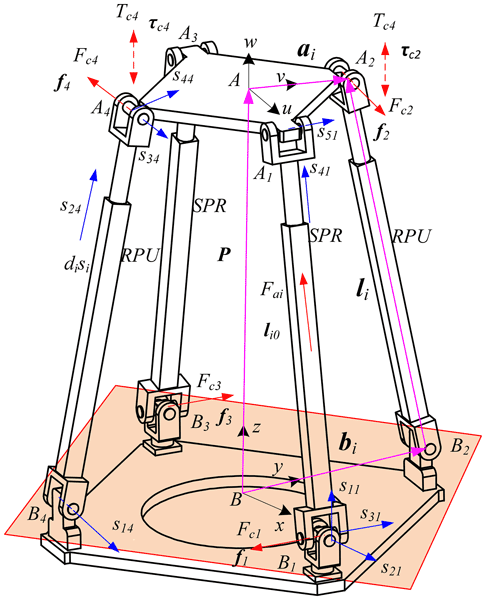
To improve the stiffness performance of the parallel mechanism, this paper proposes a novel 3-DOF redundantly actuated 2RPU-2SPR parallel mechanism. What is more, the stiffness model of the parallel mechanism is deduced and the accuracy of the stiffness model is verified through finite-element analysis. Finally, the simulation experiment results demonstrate that the redundantly actuated parallel mechanism has better stiffness performance compared to a traditional 2RPU-SPR parallel mechanism.
Changtao Yan, Kan Shi, Haiqiang Zhang, and Yanan Yao
Mech. Sci., 13, 137–146, https://doi.org/10.5194/ms-13-137-2022, https://doi.org/10.5194/ms-13-137-2022, 2022
Short summary
Short summary
Aiming at the complex control system of a quadruped robot, a leg structure of a quadruped robot was designed based on mechanism synthesis. The innovativeness of this robot is that it can achieve a special gait driven only by a single motor. Simulation and experimental analysis prove that the mechanism is reasonable, reliable and can meet the requirements of linear walking and climbing. The conclusions of this research will be useful for application in field of single actuated quadruped robots.
Haiqiang Zhang, Jianglong Tang, Qing Gao, Guohua Cui, Kan Shi, and Yan'an Yao
Mech. Sci., 13, 123–136, https://doi.org/10.5194/ms-13-123-2022, https://doi.org/10.5194/ms-13-123-2022, 2022
Short summary
Short summary
Compared with the two traditional intelligent optimization algorithms, the results show that the particle swarm optimization configuration algorithm, based on an improved orthogonal experiment design, has a better optimization effect, and the results are improved to a certain extent. The evaluation indexes of a multi-objective optimization design are often contradictory. The designer needs to compromise and select an appropriate parameter design value.
Cited articles
An, Q., Zhang, Y., Huang, X., Li, H., and Xia, X.: Impedance control in serial-parallel hybrid space robots for assembly operations, Acta Astronaut., 232, 316–329, https://doi.org/10.1016/j.actaastro.2025.03.016, 2025.
Bigdeli, M., Srivastava, R., and Scaraggi, M.: Mechanics of Space Debris Removal: A Review, Aerospace, 12, 277, https://doi.org/10.3390/aerospace12040277, 2025.
Fallahiarezoodar, N. and Zhu, Z. H.: Review of Autonomous Space Robotic Manipulators for On-Orbit Servicing and Active Debris Removal, Space: Science & Technology, 5, 0291, https://doi.org/10.34133/space.0291, 2025.
Flores-Abad, A., Ma, O., Pham, K. D., and Ulrich, S.: A review of space robotics technologies for on-orbit servicing, Prog. Aerosp. Sci., 68, 1–26, https://doi.org/10.1016/j.paerosci.2014.03.002, 2014.
Forshaw, J. L., Aglietti, G. S., Navarathinam, N., Kadhem, H., Salmon, T., Pisseloup, A., Joffre, E., Chabot, T., Retat, I., Axthelm, R., Barraclough, S., Ratcliffe, A., Bernal, C., Chaumette, F., Pollini, A., and Steyn, W. H.: RemoveDEBRIS: An in-orbit active debris removal demonstration mission, Acta Astronaut., 127, 448–463, https://doi.org/10.1016/j.actaastro.2016.06.018, 2016.
Gao, C., Huang, H., Li, B., and Jia, G.: Design of a truss-shaped deployable grasping mechanism using mobility bifurcation, Mech. Mach. Theory, 139, 346–358, https://doi.org/10.1016/j.mechmachtheory.2019.05.003, 2019.
Gao, C., Huang, H., Li, B., and Jia, G.: Design and analysis of a novel large-span two-fold deployable mechanism, Mech. Mach. Theory, 154, 104013, https://doi.org/10.1016/j.mechmachtheory.2023.105352, 2023.
Jia, G., Li, B., Huang, H., and Wu, Y.: Analysis of an underactuated biomimetic Octopus hand for grasping space non-cooperative objects, IEEE Robot., 9, 041011, https://doi.org/10.1109/CBS.2017.8266065, 2017.
Kaiser, C., Sjöberg, F., Delcura, J. M., and Eilertsen, B.: SMART-OLEV – An orbital life extension vehicle for servicing commercial spacecrafts in GEO, Acta Astronaut., 63, 400–410, https://doi.org/10.1016/j.actaastro.2007.12.053, 2008.
Li, G., Huang, H., and Guo, H.: Design, analysis and control of a novel deployable grasping manipulator, Mech. Mach. Theory, 138, 182–204, https://doi.org/10.1016/j.mechmachtheory.2019.03.043, 2019.
Liu, Y., Xu, Y., Lü, Y. P., and Song, W.: Kinematic Performance Analysis and Scale Optimization of a Fully Symmetric 4-URU Parallel Mechanism, J. Mechan. Trans., 43, 35–40, https://doi.org/10.16578/j.issn.1004.2539.2019.07.007, 2019.
Ma, B., Jiang, Z., Liu, Y., and Xie, Z.: Advances in Space Robots for On-Orbit Servicing: A Comprehensive Review, Adv. Intell. Syst., 5, 2200397, https://doi.org/10.1002/aisy.202200397, 2023.
Meng, Z. J., Huang, P., Lu, Y. B., and Hu, Y. X.: Applications and development of space tether in on-orbit servicing, J. Astronaut., 40, 1134–1145, https://doi.org/10.3873/j.issn.1000-1328.2019.10.004, 2019.
Sharf, I., Thomsen, B., Botta, E. M., and Misra, A. K.: Experiments and simulation of a net closing mechanism for tether-net capture of space debris, Acta Astronaut., 139, 332–343, https://doi.org/10.1016/j.actaastro.2017.07.026, 2017.
Tang, J., Xia, Z., Chen, Y., and Sun, Y.: Structural designs of novel deployable polyhedral grippers for noncontact capturing missions, Acta Astronaut., 170, 203–213, https://doi.org/10.1115/1.4063968, 2024.
Teoh, Z. E., Wilcox, Z. C., Xu, L., Costello, C. P., and Wood, R. J.: Rotary-actuated folding polyhedrons for midwater investigation of delicate marine organisms, Sci. Robot., 5, eabc6243, https://doi.org/10.1126/scirobotics.aat5276, 2018.
Tsiotras, P., King-Smith, M., and Ticozzi, L.: Spacecraft-mounted robotics, Annu. Rev. Control Robot. Auton. Syst., 6, 335–362, https://doi.org/10.1146/annurev-control-062122-082114, 2023.
Wang, S., Huang, H., Jia, G., Li, B., and Guo, H.: Design of a novel three-limb deployable mechanism with mobility bifurcation, Mech. Mach. Theory, 172, 104789, https://doi.org/10.1016/j.mechmachtheory.2022.104789, 2022.
Wei, G., Ding, X., and Dai, J. S.: Mobility and Geometric Analysis of the Hoberman Switch-Pitch Ball and Its Variant, J. Mech. Robot., 2, 031010, https://doi.org/10.1115/1.4001730, 2010.
Xia, Z., Tang, J., Chen, Y., and Sun, Y.: An Omnidirectional Encircled Deployable Polyhedral Gripper for Contactless Delicate Midwater Creatures Sampling, IEEE Robot. Autom. Lett., 5, 3849–3856, https://doi.org/10.1002/adem.202201416, 2020.
Xu, Y.: A closed-chain deployable claw for satellite capture, J. Mech. Robot., 15, 31–104, https://doi.org/10.3969/j.issn.1005-2895.2022.04.005, 2023.
Zhang, Y., Qian, Z., Huang, H., Yang, X., and Li, B.: A snake-inspired swallowing robot based on Hoberman's linkages, J. Mech. Robot., 14, 011005, https://doi.org/10.1115/1.4054308, 2022.
Short summary
This study addresses the challenges of capturing failed spacecraft and uncooperative space debris. Based on bionic principles, we propose a multi‑segment serial–parallel spatial closed‑chain capture mechanism, which can extend, envelop, and fix targets with high stability. Simulations and prototype tests demonstrate that the design increases capture range and flexibility, providing a feasible solution for space debris removal and failed satellite recovery.
This study addresses the challenges of capturing failed spacecraft and uncooperative space...