Articles | Volume 17, issue 2
https://doi.org/10.5194/ms-17-713-2026
© Author(s) 2026. This work is distributed under
the Creative Commons Attribution 4.0 License.
https://doi.org/10.5194/ms-17-713-2026
© Author(s) 2026. This work is distributed under
the Creative Commons Attribution 4.0 License.
Hybrid nonlinear model predictive and linear quadratic balance control for a two-wheeled self-balancing wheelchair

Haomin Sun
Institute of Intelligent Rehabilitation Engineering, University of Shanghai for Science and Technology, Shanghai, China
Shanghai Engineering Research Center of Assistive Devices, Shanghai, 200093, China
Key Laboratory of Neural-functional Information and Rehabilitation Engineering of the Ministry of Civil Affairs, Shanghai, 200093, China
Xinying Zhang
Institute of Intelligent Rehabilitation Engineering, University of Shanghai for Science and Technology, Shanghai, China
Shanghai Engineering Research Center of Assistive Devices, Shanghai, 200093, China
Key Laboratory of Neural-functional Information and Rehabilitation Engineering of the Ministry of Civil Affairs, Shanghai, 200093, China
Yaozhi Gu
Institute of Intelligent Rehabilitation Engineering, University of Shanghai for Science and Technology, Shanghai, China
Shanghai Engineering Research Center of Assistive Devices, Shanghai, 200093, China
Key Laboratory of Neural-functional Information and Rehabilitation Engineering of the Ministry of Civil Affairs, Shanghai, 200093, China
Shuai Wang
Institute of Intelligent Rehabilitation Engineering, University of Shanghai for Science and Technology, Shanghai, China
Shanghai Engineering Research Center of Assistive Devices, Shanghai, 200093, China
Key Laboratory of Neural-functional Information and Rehabilitation Engineering of the Ministry of Civil Affairs, Shanghai, 200093, China
Weiyue Chen
Institute of Intelligent Rehabilitation Engineering, University of Shanghai for Science and Technology, Shanghai, China
Shanghai Engineering Research Center of Assistive Devices, Shanghai, 200093, China
Key Laboratory of Neural-functional Information and Rehabilitation Engineering of the Ministry of Civil Affairs, Shanghai, 200093, China
Shuyue Zhang
Institute of Intelligent Rehabilitation Engineering, University of Shanghai for Science and Technology, Shanghai, China
Shanghai Engineering Research Center of Assistive Devices, Shanghai, 200093, China
Key Laboratory of Neural-functional Information and Rehabilitation Engineering of the Ministry of Civil Affairs, Shanghai, 200093, China
Tianyu Xu
Institute of Intelligent Rehabilitation Engineering, University of Shanghai for Science and Technology, Shanghai, China
Shanghai Engineering Research Center of Assistive Devices, Shanghai, 200093, China
Key Laboratory of Neural-functional Information and Rehabilitation Engineering of the Ministry of Civil Affairs, Shanghai, 200093, China
Hongliu Yu
Institute of Intelligent Rehabilitation Engineering, University of Shanghai for Science and Technology, Shanghai, China
Shanghai Engineering Research Center of Assistive Devices, Shanghai, 200093, China
Key Laboratory of Neural-functional Information and Rehabilitation Engineering of the Ministry of Civil Affairs, Shanghai, 200093, China
Institute of Intelligent Rehabilitation Engineering, University of Shanghai for Science and Technology, Shanghai, China
Shanghai Engineering Research Center of Assistive Devices, Shanghai, 200093, China
Key Laboratory of Neural-functional Information and Rehabilitation Engineering of the Ministry of Civil Affairs, Shanghai, 200093, China
Related authors
No articles found.
Cuizhi Fei, Zongqi Jiao, Qiaoling Meng, Bangke Zhang, and Xuhua Lu
Mech. Sci., 17, 453–467, https://doi.org/10.5194/ms-17-453-2026, https://doi.org/10.5194/ms-17-453-2026, 2026
Short summary
Short summary
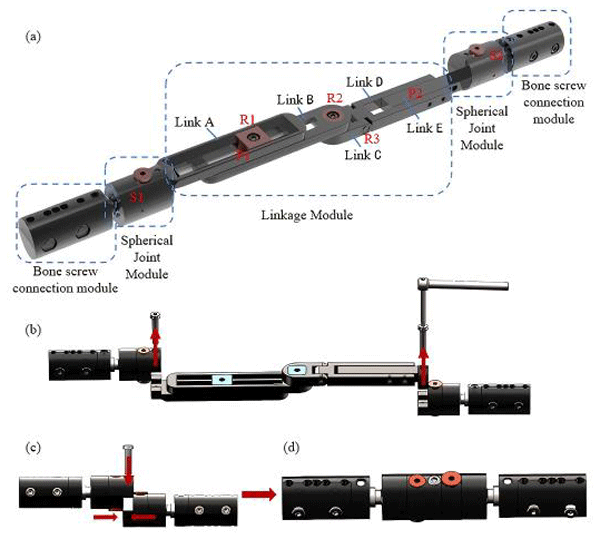
The reconfigurable external fixation based on the seven-link mechanism has configurations in multiple dimensions, multiple postures, and multiple fracture scenarios, enabling rapid and stable fixation of fractures in the femur, tibia, elbow joint, knee joint, and ankle joint. It has been verified that this external fixation has stable structure and reliable fixation and significantly shortens the operation time and can be used for temporary fracture fixation in emergency medical scenarios.
Rongna Xu, Qiaoling Meng, Qiaolian Xie, Yuxin Zheng, Cuizhi Fei, Vincenzo Parenti Castelli, and Hongliu Yu
Mech. Sci., 16, 61–73, https://doi.org/10.5194/ms-16-61-2025, https://doi.org/10.5194/ms-16-61-2025, 2025
Short summary
Short summary
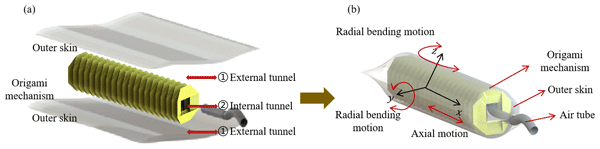
This paper proposes a novel dual-tunnel soft pneumatic origami actuator to provide a large maximum shrinkage rate for reciprocating motion. A programmed design method is proposed based on the geometric parameter model and stiffness model of the actuator. In comparison to other actuators, this actuator weighs only 5 g, and the force-to-weight ratio is 600. The maximum shrinkage rate of the actuator is 61 %, increasing the potential for lightweight and compact devices.
Qiaolian Xie, Qiaoling Meng, Wenwei Yu, Rongna Xu, Zhiyu Wu, Xiaoming Wang, and Hongliu Yu
Mech. Sci., 14, 159–170, https://doi.org/10.5194/ms-14-159-2023, https://doi.org/10.5194/ms-14-159-2023, 2023
Short summary
Short summary
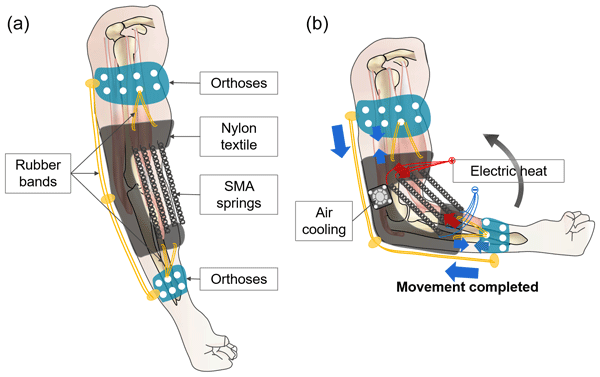
This paper presents a novel soft bionic elbow exoskeleton based on shape metal alloy (SMA) actuators (Sobee-SMA). The exoskeleton adopts a bionic design, combining active deformation material SMA and high elastic material rubber band to simulate the contraction and relaxation of the elbow skeletal muscle. According to the static analysis of the human–exoskeleton coupling model and experiments, the exoskeleton provides elbow-assisted motion and ensures the safety of the thermal heating process.
Qiaoling Meng, Yiming Yue, Sujiao Li, and Hongliu Yu
Mech. Sci., 13, 675–685, https://doi.org/10.5194/ms-13-675-2022, https://doi.org/10.5194/ms-13-675-2022, 2022
Short summary
Short summary
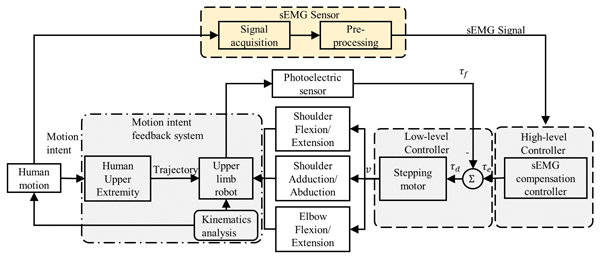
This paper proposes a novel EMG-based motion compensation controller in active training control to improve patients’ active participation. After proposing an upper limb rehabilitation robot and doing the path plan, the EMG compensation experiments and the active training control experiment are done to prove that the method can control the robot in providing auxiliary force according to patients’ motion intents. The robot can guide the patients in implementing reference tasks in active training.
Qiaoling Meng, Mingpeng Jiang, Zongqi Jiao, and Hongliu Yu
Mech. Sci., 13, 1–13, https://doi.org/10.5194/ms-13-1-2022, https://doi.org/10.5194/ms-13-1-2022, 2022
Short summary
Short summary
This paper proposes a bionic, multi-posture wheelchair, based on the proposed human–wheelchair coupling model, according to the movement characteristics and requirements. The two key factors in designing the multi-posture wheelchair, the consistency of the motion center and the compensation of the shifting center of gravity, are analyzed in this paper. The novel multi-posture wheelchair can implement the sit-to-lie and sit-to-stand transformations with a maximum slipping distance of 10.5 mm.
Cited articles
Chacko, S. J. and Abraham, R. J.: On LQR controller design for an inverted pendulum stabilization, Int. J. Dynam. Control, 11, 1584–1592, https://doi.org/10.1007/s40435-022-01079-0, 2023.
Chénier, F., Marquis, E., and Fleury-Rousseau, M.: Tracking the whole-body centre of mass of humans seated in a wheelchair using motion capture, J. Biomech., 156, 111675, https://doi.org/10.1016/j.jbiomech.2023.111675, 2023.
Cui, R., Guo, J., and Mao, Z.: Adaptive backstepping control of wheeled inverted pendulums models, Nonlinear Dynam., 79, 501–511, https://doi.org/10.1007/s11071-014-1682-9, 2015.
Dai, F., Gao, X., Jiang, S., Guo, W., and Liu, Y.: A two-wheeled inverted pendulum robot with friction compensation, Mechatronics, 30, 116–125, https://doi.org/10.1016/j.mechatronics.2015.06.011, 2015.
Feng, X., Liu, S., Yuan, Q., Xiao, J., and Zhao, D.: Research on wheel-legged robot based on LQR and ADRC, Sci. Rep., 13, 15122, https://doi.org/10.1038/s41598-023-41462-1, 2023.
Huynh, H. N., Verlinden, O., and Vande Wouwer, A.: Comparative application of model predictive control strategies to a wheeled mobile robot, J. Intell. Robot. Syst., 87, 81–95, https://doi.org/10.1007/s10846-017-0500-2, 2017.
Kim, S. and Kwon, S.: Dynamic modeling of a two-wheeled inverted pendulum balancing mobile robot, Int. J. Control Autom. Syst., 13, 926–933, https://doi.org/10.1007/s12555-014-0564-8, 2015.
Kim, Y., Kim, S. H., and Kwak, Y. K.: Dynamic analysis of a nonholonomic two-wheeled inverted pendulum robot, J. Intell. Robot. Syst., 44, 25–46, https://doi.org/10.1007/s10846-005-9022-4, 2005.
Li, J., Wang, J., Wang, S., Qi, W., Zhang, L., Hu, Y., and Su, H.: Neural approximation-based model predictive tracking control of non-holonomic wheel-legged robots, Int. J. Control Autom. Syst., 19, 372–381, https://doi.org/10.1007/s12555-019-0927-2, 2021.
Li, Z. and Zhang, Y.: Robust adaptive motion/force control for wheeled inverted pendulums, Automatica, 46, 1346–1353, https://doi.org/10.1016/j.automatica.2010.05.015, 2010.
Liang, S., Wang, Z., and Stepan, G.: Motion control of a two-wheeled inverted pendulum with uncertain rolling resistance and angle constraint based on slow-fast dynamics, Nonlinear Dynam., 104, 2185–2199, https://doi.org/10.1007/s11071-021-06439-7, 2021.
Liu, C., Qin, K., Xin, G., Li, C., and Wang, S.: Nonlinear model predictive control for a self-balancing wheelchair, IEEE Access, 12, 28938–28949, https://doi.org/10.1109/ACCESS.2024.3368853, 2024.
Ma, Y., Meng, F., and Xiong, S.: Design and implementation of a two-wheeled self-balancing car using a fuzzy Kalman filter, Appl. Sci., 14, 5296, https://doi.org/10.3390/app14125296, 2024.
Onozuka, Y., Tomokuni, N., Murata, G., and Shino, M.: Attitude control of an inverted-pendulum-type robotic wheelchair to climb stairs considering dynamic equilibrium, Robomech J., 7, 23, https://doi.org/10.1186/s40648-020-00171-4, 2020.
Saleem, O., Mahmood-ul-Hasan, K., and Rizwan, M.: An experimental comparison of different hierarchical self-tuning regulatory control procedures for under-actuated mechatronic systems, PLOS ONE, 16, e0256750, https://doi.org/10.1371/journal.pone.0256750, 2021.
Saleem, O., Iqbal, J., and Alharbi, S.: Self-regulating fuzzy-LQR control of an inverted pendulum system via adaptive hyperbolic error modulation, Machines, 13, 939, https://doi.org/10.3390/machines13100939, 2025. a
Shen, J. and Hong, D.: Model predictive control using dynamic model decomposition applied to two-wheeled inverted pendulum mobile robot, in: 2022 19th International Conference on Ubiquitous Robots (UR), Jeju, Republic of Korea, 332–337, https://doi.org/10.1109/UR55393.2022.9826244, 2022.
Xin, G., Jin, B., Liu, C., and Jiang, M.: A unified control framework for self-balancing robots: addressing model variations in wheel-legged platforms and human-carrying wheelchairs, Sensors, 25, 7144, https://doi.org/10.3390/s25237144, 2025.
Yan, C. and Li, X.: Research on stability control system of two-wheel heavy-load self-balancing vehicles in complex terrain, Appl. Sci., 14, 7682, https://doi.org/10.3390/app14177682, 2024.
Zhang, A., Zhou, R., Zhang, T., Zheng, J., and Chen, S.: Balance control method for bipedal wheel-legged robots based on friction feedforward linear quadratic regulator, Sensors, 25, 1056, https://doi.org/10.3390/s25041056, 2025.
Zhang, B. and Wu, G.: Design of two-wheel self-balancing vehicle based on visual identification, EURASIP J. Image Video Process., 2019, 34, https://doi.org/10.1186/s13640-019-0434-7, 2019.
Zhang, H. and Mohamad Nor, N.: Control strategies for two-wheeled self-balancing robotic systems: a comprehensive review, Robotics, 14, 101, https://doi.org/10.3390/robotics14080101, 2025.
Zhang, Z., Xu, P., Wu, C., and Yu, H.: Smart nursing wheelchairs: a new trend in assisted care and the future of multifunctional integration, Biomimetics, 9, 492, https://doi.org/10.3390/biomimetics9080492, 2024.
Short summary
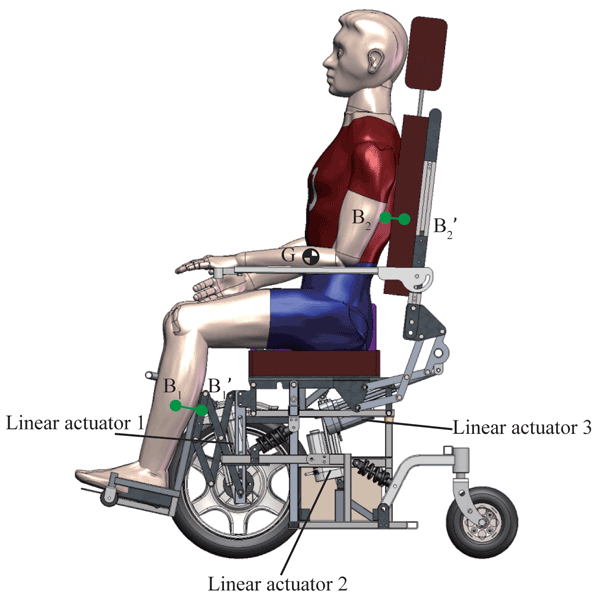
Self-balancing wheelchairs can help people move in tight spaces, but they must stay upright when starting from a large tilt, carrying different users, or facing sudden pushes. We developed and tested a two-stage control approach that first brings the chair back safely from larger tilts and then keeps it steady near upright. Simulations and prototype tests showed faster recovery, better stability under disturbances, and stronger tolerance to user-weight changes, supporting safer designs.
Self-balancing wheelchairs can help people move in tight spaces, but they must stay upright when...