Articles | Volume 17, issue 2
https://doi.org/10.5194/ms-17-799-2026
© Author(s) 2026. This work is distributed under
the Creative Commons Attribution 4.0 License.
https://doi.org/10.5194/ms-17-799-2026
© Author(s) 2026. This work is distributed under
the Creative Commons Attribution 4.0 License.
An effective prediction model for dynamic wear evolution of unmodified and modified helical gear pairs

Bing Yuan
CORRESPONDING AUTHOR
School of Mechatronic Engineering, Xi'an Technological University, Xi'an 710021, China
Yuzheng Tan
School of Mechatronic Engineering, Xi'an Technological University, Xi'an 710021, China
Songtao Zhao
Harbin Marine Boiler and Turbine Research Institute, Harbin, 150078, China
School of Mechanical Engineering, Tongji University, Shanghai 201804, China
Jingyi Gong
School of Mechanical Engineering, Xi'an Shiyou University, Xi'an 710065, China
School of Mechatronic Engineering, Xi'an Technological University, Xi'an 710021, China
Related authors
Jingyi Gong, Kaiyang Chen, Ruikai Dai, Haipeng An, Guanghao Dai, and Bing Yuan
Mech. Sci., 17, 1003–1021, https://doi.org/10.5194/ms-17-1003-2026, https://doi.org/10.5194/ms-17-1003-2026, 2026
Short summary
Short summary
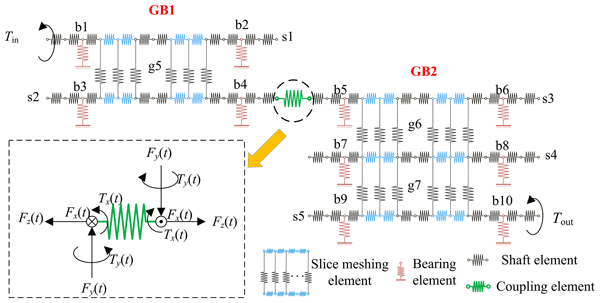
This study establishes a gear contact and dynamic model that incorporates coupling misalignment. Misalignment generates mesh stiffness fluctuations at twice the shaft frequency and asymmetric load distribution across double-helical gear tooth surfaces. It triggers tooth separation under light loads and disengagement at resonance. Greater misalignment and input torque exacerbate system vibration, whereas torque predominantly influences vibration responses excited by the gear meshing frequency.
Hao Dong, Yue Bi, Zhen-Bin Liu, and Xiao-Long Zhao
Mech. Sci., 12, 1093–1104, https://doi.org/10.5194/ms-12-1093-2021, https://doi.org/10.5194/ms-12-1093-2021, 2021
Short summary
Short summary
In order to solve the problem of the nonlinear frequency response of a planetary gear transmission system, based on the lumped parameter theory, a nonlinear frequency response model with a bending torsion coupling of a planetary gear system is established by comprehensively considering the backlash, support clearance, time-varying meshing stiffness, static transmission error, external periodic excitation and other factors.
Short summary
We developed a wear model for helical gears with surface modifications, coupling wear with dynamic contact forces and a dynamic wear coefficient. Unlike traditional constant‑rate models, our approach captures real‑time changes in contact stress. Results show wear has little effect on gear stiffness, but its distribution varies strongly with modification type, which also alters vibration evolution. This work aids selection of surface designs to improve gear reliability and reduce noise.
We developed a wear model for helical gears with surface modifications, coupling wear with...