Articles | Volume 17, issue 1
https://doi.org/10.5194/ms-17-313-2026
© Author(s) 2026. This work is distributed under
the Creative Commons Attribution 4.0 License.
https://doi.org/10.5194/ms-17-313-2026
© Author(s) 2026. This work is distributed under
the Creative Commons Attribution 4.0 License.
Review article: A review of control technologies for soft robots: from structural design to intelligent control
Huijun Yu
School of Mechanical and Electrical Engineering, University of Electronic Science and Technology of China, Chengdu 611731, China
Min Lv
School of Mechanical and Electrical Engineering, University of Electronic Science and Technology of China, Chengdu 611731, China
Bin Hu
Thoracic Surgery Department, Sichuan Cancer Hospital and Institute, Chengdu, China
Yang Zhang
School of Mechanical and Electrical Engineering, University of Electronic Science and Technology of China, Chengdu 611731, China
Related authors
Huijun Yu, Jiahao Lin, Ruimin Tan, Kang Liu, and Pengyuan Zhao
Mech. Sci., 17, 657–670, https://doi.org/10.5194/ms-17-657-2026, https://doi.org/10.5194/ms-17-657-2026, 2026
Short summary
Short summary
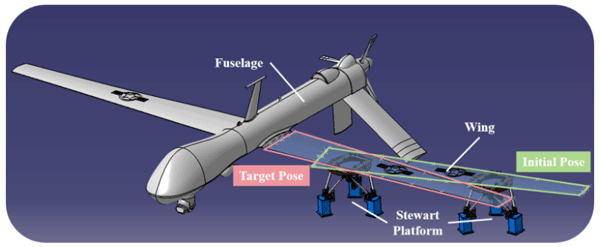
This study proposes a novel dual-robot system controlled by a primary–secondary strategy for accurately aligning large, flexible aircraft parts in tight spaces. The primary robot ensures precise positioning, while the secondary robot actively senses and cancels out harmful internal forces, preventing part deformation. Our simulated results show that this method achieves high alignment accuracy and reduces internal forces by over 90.03 %, offering a safe and efficient automated solution for aircraft assembly.
Huijun Yu, Jiahao Lin, Ruimin Tan, Kang Liu, and Pengyuan Zhao
Mech. Sci., 17, 657–670, https://doi.org/10.5194/ms-17-657-2026, https://doi.org/10.5194/ms-17-657-2026, 2026
Short summary
Short summary
This study proposes a novel dual-robot system controlled by a primary–secondary strategy for accurately aligning large, flexible aircraft parts in tight spaces. The primary robot ensures precise positioning, while the secondary robot actively senses and cancels out harmful internal forces, preventing part deformation. Our simulated results show that this method achieves high alignment accuracy and reduces internal forces by over 90.03 %, offering a safe and efficient automated solution for aircraft assembly.
Short summary
Soft robots promise healthcare and exploration gains, but nonlinear ever-bending bodies defy control. This paper reviews recent advances in diverse structures and actuation mechanisms, modeling approaches integrating classical and modern techniques, trajectory planning balancing obstacle avoidance and optimization, and control strategies covering both model-based and model-free methods. Future work must overcome bottlenecks such as low actuation efficiency and poor real-time performance.
Soft robots promise healthcare and exploration gains, but nonlinear ever-bending bodies defy...