Articles | Volume 16, issue 2
https://doi.org/10.5194/ms-16-877-2025
© Author(s) 2025. This work is distributed under
the Creative Commons Attribution 4.0 License.
https://doi.org/10.5194/ms-16-877-2025
© Author(s) 2025. This work is distributed under
the Creative Commons Attribution 4.0 License.
A lightweight optimization framework for real-time pedestrian detection in dense and occluded scenes

Cui Chen
CORRESPONDING AUTHOR
Chongqing Vocational and Technical University of Mechatronics, Chongqing 402760, China
Jun Li
CORRESPONDING AUTHOR
Chongqing Vocational and Technical University of Mechatronics, Chongqing 402760, China
School of Mechatronics and Vehicle Engineering, Chongqing Jiaotong University, Chongqing 400074, China
Zequn Shuai
School of Mechatronics and Vehicle Engineering, Chongqing Jiaotong University, Chongqing 400074, China
Yiyun Wang
Chongqing Vocational and Technical University of Mechatronics, Chongqing 402760, China
Yaohong Wang
Chongqing Academy of Metrology and Quality Inspection, Chongqing 400020, China
Related authors
No articles found.
Yi Zhang, Anhua Zhou, and Jun Li
Mech. Sci. Discuss., https://doi.org/10.5194/ms-2026-168, https://doi.org/10.5194/ms-2026-168, 2026
Preprint under review for MS
Short summary
Short summary
Autonomous vehicles must detect nearby road users quickly and reliably, even when objects are partly hidden. We developed a lightweight camera-based method that adapts its processing to scene difficulty, combines information across video frames, and learns from laser-sensor data during training. It reached 38.7% on the benchmark detection measure and processed 26.2 frames per second without laser sensors during use, showing strong potential for fast, lower-cost vehicle perception.
Rui Xu, Jun Li, Shiyi Zhang, Lei Li, Hulin Li, Guiying Ren, and Xinglong Tang
Mech. Sci., 16, 87–97, https://doi.org/10.5194/ms-16-87-2025, https://doi.org/10.5194/ms-16-87-2025, 2025
Short summary
Short summary
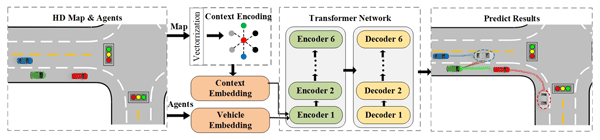
A trajectory prediction model based on Transfomer has been proposed to address the issue of long-term prediction accuracy in complex traffic environments. Optimizing multi-head attention based on knowledge of the scene context and vehicle position generates interactions between maps and agents, as well as between agents themselves. Its effectiveness has been evaluated on the basis of the outdoor dataset, and higher precision was achieved.
Short summary
We developed a fast and compact model to detect pedestrians in crowded scenes, especially when people are partly hidden or far away. Our method improves how the model learns from small and difficult cases, and how it balances speed and accuracy. It runs much faster than current systems while maintaining similar accuracy, making it suitable for real-time use on mobile and edge devices.
We developed a fast and compact model to detect pedestrians in crowded scenes, especially when...